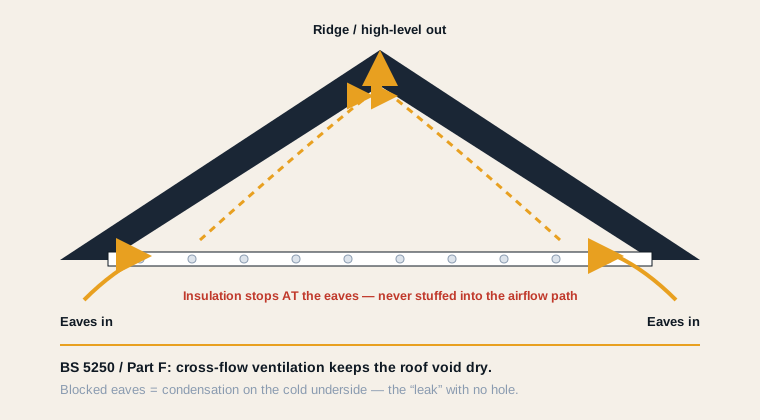
Roof ventilation is rarely discussed when homeowners are thinking about roofing work, but it is one of the factors that most determines how long a roof structure lasts between re-roofs. On Coventry’s post-war housing stock — properties built predominantly between 1945 and 1980 — inadequate ventilation is widespread and is a primary cause of the rafter and ridge board rot we find at survey stage.
The Ventilation Problem on Post-War Coventry Properties
Post-war building standards did not require the ventilation provisions that current regulations specify. Many Coventry properties built in this period have minimal or no eaves ventilation — the soffit board is solid, the tiles run to within millimetres of the fascia, and there is no path for air to circulate through the roof space.
The consequence is condensation. Warm moist air from the living space rises into the loft and cannot escape. As it contacts the cold underside of the roof structure, it condenses. In a well-ventilated loft, this moisture would be carried away by airflow. In an under-ventilated one, it accumulates on the felt, battens and rafters.
BS 5250 requires a minimum 25mm continuous ventilation gap at the eaves for cold pitched roofs using breathable membrane.
Source: BS 5250:2021 (management of moisture in buildings)
What Happens Without Adequate Ventilation
Persistent condensation on timber causes decay. The process is slow but progressive:
- Batttens: Moisture cycling eventually causes the underside of battens to become soft, reducing their ability to hold tile nails securely
- Rafter feet: Condensation runs down the underside of the felt and collects at the lowest point — the rafter foot at the eaves. This is the most common site of timber rot on under-ventilated Coventry properties
- Ridge board and hip rafters: Central structural timbers are less commonly affected but deteriorate in persistently damp roof spaces
- Insulation: Saturated loft insulation loses its thermal properties and needs replacement
What We Specify on Coventry Re-Roofs
On every re-roof in Coventry, we specify breathable (vapour-permeable) underlay as standard, replacing the impermeable bitumen felt that was the original system. Breathable membrane significantly reduces condensation risk compared to impermeable felt — it allows water vapour to pass through rather than collecting on the cold surface.
We also fit ventilated eaves and ridge systems on any Coventry property where the existing ventilation is inadequate. The cost addition is modest — £200–£500 on a standard re-roof — and it is one of the highest-return investments available during a re-roof project.
Free Roof and Loft Survey in Coventry
We check ventilation and timber condition on every survey across CV postcodes.
📞 Call 0247 798 1271 — Free Quote