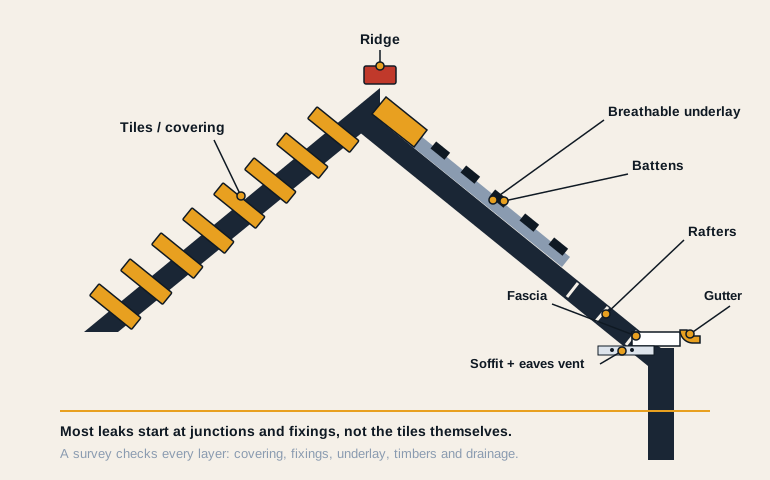
The tile on your roof determines how long it lasts, what repairs cost, and what materials are available when something goes wrong. Understanding which tile type you have and what its characteristics are is the foundation of sensible roof maintenance planning. This guide covers the main types found across Coventry’s housing stock.
The Four Main Tile Types in Coventry
1. Concrete Interlocking Tiles — Post-War Estates
Concrete interlocking tiles are the dominant covering on Coventry’s post-war estate belt — the housing built across CV2, CV3, CV4 and CV6 between 1945 and 1985. They interlock side-to-side and head-to-tail, creating a tight, low-profile covering on relatively shallow-pitched roofs. At 50–60 years of age, most of this stock is approaching or past the nail sickness window.
Design life: 50–60 years. Common profiles in Coventry: Redland 49, Marley Mendip, Eternit Ashmore. Each profile requires its own matching tile for repairs — a tile from a different manufacturer will not interlock correctly. We carry the most common CV postcode profiles in stock.
2. Clay Plain Tiles — Interwar Semis
Clay plain tiles are the correct covering for Coventry’s 1930s semi-detached stock in Coundon, Radford, Canley, Whitmore Park and the surrounding interwar suburbs. They are smaller than interlocking tiles (265mm × 165mm standard), double-lapped, and hung on a closer batten gauge. The double-lap means each tile is covered by two tiles above it — providing better weather protection on the shallower pitches common on 1930s roofs.
Design life: 60–80 years. Modern clay plain tiles are available new, but reclaimed matching stock is often preferred for repair work on 1930s properties where colour consistency matters. Do not replace clay plain tile with concrete interlocking on a 1930s roof — the batten gauge, pitch angle and overlap requirements are incompatible.
3. Natural Welsh Slate — Victorian and Edwardian Properties
Natural Welsh slate was the original roofing material on Coventry’s Victorian and Edwardian terraces in Earlsdon, Hillfields, and parts of Foleshill. It has a design life of 80–150 years from quality quarry sources. The slate itself rarely fails — what fails are the fixing nails (copper or zinc, lasting 80–100 years), the ridge and hip mortar, and the lead flashings.
Repair work on Victorian Coventry properties requires reclaimed Welsh slate matched to the original source as closely as possible — Penrhyn, Ffestiniog and Cornish slates have different thicknesses, textures and weathering colours. Using the wrong source creates a visible patch. We carry matched reclaimed stock for the most common profiles found on CV1 and CV5 period properties.
4. Artificial Slate — Modern Alternative
Artificial slate (fibre cement or polymer) is a manufactured product designed to replicate the appearance of natural slate at lower cost. Design life 40–50 years. Appropriate for non-conservation properties where authentic materials are not required. Brands like Marley Edgemere and Cedral are widely used on Coventry re-roofs where budget is the primary consideration. Not appropriate for conservation area properties or listed buildings where material matching is specified.
Concrete and clay roofing tiles for UK use must achieve BS EN 1304 frost-resistance category F2 for severe wet-frost conditions.
Source: BS EN 1304 (roofing tile standards)
Tile Lifespan Comparison
| Tile Type | Design Life | Common Failure Mode | Coventry Prevalence |
|---|---|---|---|
| Concrete interlocking | 50–60 years | Nail sickness | Dominant on post-war estates |
| Clay plain tile | 60–80 years | Nail failure, mortar erosion | 1930s interwar stock |
| Natural Welsh slate | 80–150 years | Nail failure, not the slate | Victorian / Edwardian stock |
| Artificial slate | 40–50 years | UV degradation, delamination | Post-2000 re-roofs |
Getting a Tile Match Right
Tile matching for repair work is one of the most underestimated aspects of roofing in Coventry. A visibly mismatched tile on a front slope — wrong colour, wrong profile, wrong weathering pattern — is noticeable and affects kerb appeal. We do not proceed with repair work until we have confirmed the tile match.
For concrete interlocking tiles, the profile is the primary constraint — an incompatible profile will not interlock correctly, regardless of colour. For clay plain tile, colour consistency matters more than profile. For Welsh slate, thickness, colour and weathering pattern are all significant. We confirm matching during the free survey and will tell you honestly if a close match is not achievable.
Free Survey and Tile Assessment in Coventry
We identify your tile type and confirm matchability before quoting. Call 0247 798 1271.
📞 Call 0247 798 1271 — Free Quote