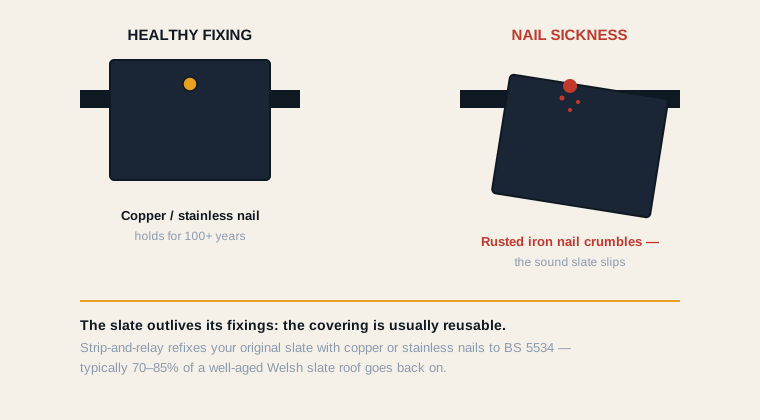
If you live on one of Coventry’s post-war estates and your tiles have been slipping, or you’ve had the same section repaired more than once, nail sickness is probably the cause. It’s the single most common roofing diagnosis we make across CV2, CV3, CV4 and CV6 — and it’s entirely predictable given the age of the housing stock.
What Is Nail Sickness?
Concrete roof tiles are fixed to the timber battens beneath them using galvanised steel nails. Galvanised means zinc-coated to resist corrosion. That zinc coating has a finite service life — typically 40–60 years under normal UK weather conditions.
When the zinc coating fails, the steel core begins to corrode. Rust expands as it forms, weakening the nail’s grip and physically pushing the tile away from its fixing point. The result: tiles that slip progressively out of position — first by millimetres, then by centimetres, eventually falling entirely.
This is nail sickness. The name refers to the sick fixings, not the tiles themselves — the tiles are often still structurally sound, just no longer held in place.
Galvanised steel roofing nails have a service life of 50–70 years before zinc-coating corrosion causes structural failure and progressive tile slippage.
Source: BS 5534:2018 fixing specifications
Why Coventry Is Particularly Affected
Nail sickness is a national problem on post-war housing, but Coventry has a higher concentration of affected properties than most comparable cities. The reason is Coventry’s specific post-war history.
The Blitz of November 1940 destroyed a significant proportion of Coventry’s housing stock. The reconstruction programme that followed built tens of thousands of new homes between 1945 and 1975 — the Canley, Wyken, Bell Green, Cheylesmore, Coundon and Wood End estates were all products of this era, all roofed with concrete interlocking tiles and galvanised fixings.
Those roofs are now 50–80 years old. The nails are at or past their design life. Nail sickness is not an occasional problem in Coventry — it’s a near-universal condition across the post-war estate belt.
The affected postcodes: CV2 (Wyken, Bell Green, Binley), CV3 (Cheylesmore, Whitley, Stivichall), CV4 (Canley, Tile Hill) and CV6 (Coundon, Radford, Foleshill) all contain large concentrations of nail-sick roofs. If your property was built between 1950 and 1980 in any of these areas, a survey is worth having.
How to Spot Nail Sickness from the Ground
From the pavement outside your property, look for:
- Slipped tiles: One or more tiles sitting lower than the row, with a corner dipping out of line
- Gaps in the tile profile: Visible gaps where adjacent tiles should overlap
- Broken tiles at the nail point: Cracks radiating from where the nail passes through the tile
- Uneven ridge line: Any dips or bumps suggest mortar or fixing failure
From inside the loft:
- Rusted nail heads: Visible orange rust where nails pass through the batten
- Loose tiles: Tiles that can be moved by hand from below
- Daylight visible between tiles: Gaps showing light where there should be overlap
- Water staining on the felt: Marks indicating past or current ingress
What Happens If You Ignore Nail Sickness
Nail sickness is progressive. Once the zinc coating has failed on one nail, the surrounding nails are at the same corrosion stage. Practically:
- Each storm event dislodges more tiles, increasing injury or damage risk
- Water enters through gaps, initially held by the felt underlay
- The felt underlay is also 50–70 years old and fails shortly after tiles begin to slip
- Once felt fails, water reaches the timber structure — causing rot in battens, rafters, ridge board and wall plate
- Timber rot adds £500–£2,000 to the eventual re-roofing cost
Book a Free Nail Sickness Survey
We survey Coventry properties across CV2, CV3, CV4 and CV6. No call-out fee.
📞 Call 0247 798 1271 — Free QuoteRepair or Replace? The Nail Sickness Decision
| Extent of Nail Sickness | Recommendation | Typical Cost |
|---|---|---|
| Under 15% of tiles affected | Targeted re-fixing, monitor annually | £400–£700 |
| 15–30% affected | Partial or full re-roof depending on felt condition | £2,000–£5,000 |
| Over 30% affected | Full re-roof | £4,500–£7,000 |
| Over 30% + failed felt | Full re-roof including timber inspection | £5,000–£8,000 |
These are honest thresholds. Some roofers will recommend replacement at much lower levels of nail sickness to increase job value. Others offer repeated cheap repairs that delay but don’t solve the problem. Neither serves the homeowner. We survey, report the extent accurately, and give you a recommendation based on what we actually find.
What a Re-Roof Involves on a Nail-Sick Property
- Stripping all existing tiles and battens
- Inspecting every rafter, the ridge board and wall plate for rot — replacing affected timber
- Installing new breathable membrane (replacing the failed felt underlay)
- Re-battening to current BS 5534 specification using treated timber
- Re-tiling with new concrete or clay tiles, fixed with stainless steel nails — no recurrence of nail sickness
- Re-bedding ridge and hip tiles in flexible mortar
- Checking and re-sealing all flashings
The result is a roof that will not require significant attention for another 50–60 years. Stainless steel fixings do not corrode, so the nail sickness cycle does not repeat.
Get a Free Re-Roof Quote
Covering all nail-sick estates across Coventry. Written quote, 10-year guarantee.
📞 Call 0247 798 1271 — Free Quote