⚡ Emergency roof repairs 24/7 — Call now: 0247 798 1271
🔧 Technical Guide · Coventry

Lead Flashing on Coventry Roofs

What lead flashing is, how it works, why it fails on Coventry’s period housing stock, and what correctly specified repairs cost across CV postcodes.

Lead flashing waterproofs the junction between a roof and a chimney, wall or valley. It fails through decades of thermal movement that cracks folds and erodes the mortar fixing. On Coventry’s Victorian properties, flashings 100+ years old need re-dressing or replacement in code 4 or 5 lead.

Lead flashing failure is the most common cause of water ingress on Coventry’s Victorian and Edwardian properties. It is the roofing detail that causes the most ceiling damage and is the most frequently bodged with temporary silicone fixes. Understanding what it is and how it fails helps homeowners make better decisions about repair options.

What Lead Flashing Does

Wherever a roof surface meets a vertical element — a chimney stack, a party wall between terraces, a dormer side wall, or a parapet wall — there is a junction that cannot be sealed with tiles alone. Lead flashing covers this junction, overlapping both the tile course below and the brickwork above, and is sealed into a raked mortar joint in the brickwork at its top edge.

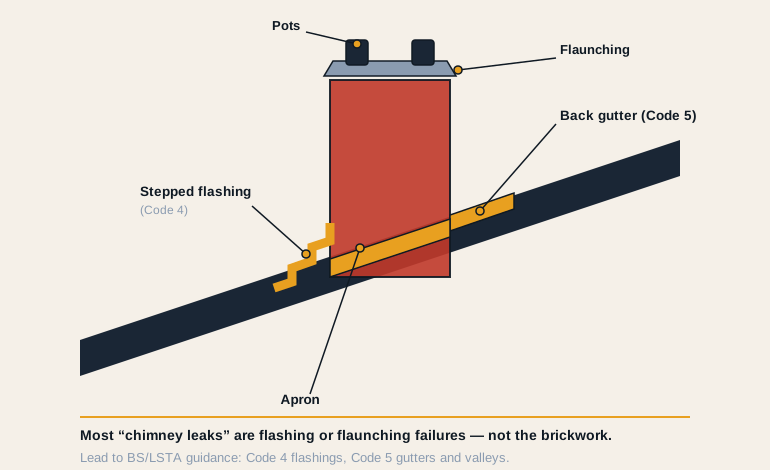
There are several types of lead flashing: step flashing (the stepped strips that run up the side of a chimney alongside the tile course), back gutter (the horizontal strip across the back of a chimney at the high side of the roof), soakers (individual lead pieces beneath step flashings), and valley lead (the continuous lead lining in the valley where two roof slopes meet).

Code 4 lead (1.8mm) is the minimum specification for chimney flashings; code 5 (2.24mm) is correct for valleys under BS 6915.

Source: BS 6915 (design and construction of lead sheet roofing)

Why Lead Flashing Fails

Lead has an unusually high coefficient of thermal expansion — it moves significantly more with temperature change than most building materials. A lead flashing on a south-facing Coventry chimney might reach 60–70°C in summer and drop to −5°C in winter — a 75° range that creates constant movement at every fold, edge and fixing point. Over 50 to 100 years, this movement eventually opens a gap.

The most common failure points are: the top edge where the lead is wedged into the mortar joint (mortar erodes and the wedge loosens), fold points where step flashings change angle (cracks develop after repeated bending), and lap joints in valley lead (thermal expansion eventually opens the overlap).

The silicone trap: Applying silicone over a lifted or cracked flashing is a 2–3 year fix. The lead continues to move, the silicone cracks, and water enters. Every property we survey that has had silicone applied to flashings needs proper re-dressing or replacement. The silicone does not solve the movement problem.

Lead Flashing on Coventry’s Period Stock

Victorian and Edwardian terraces in Earlsdon and Hillfields have the highest concentration of original or early-replacement lead flashings in Coventry. Properties built between 1880 and 1910 have flashings that are now 115–145 years old. Well-installed original lead can reach this age in serviceable condition — but the mortar that fixes it into the brick joint has almost certainly degraded, and the soakers beneath step flashings on chimney sides are the first to go.

1930s properties in Coundon, Radford and Canley have lead that is 85–95 years old — approaching design life but often still sound. The question at survey is whether there is residual life worth preserving or whether re-leading is more cost-effective than repeated repairs.

Free Lead Flashing Survey in Coventry

We assess condition and quote honestly for repair or replacement.

📞 Call 0247 798 1271 — Free Quote

Practical Application in Coventry

The principles described in this guide apply across Coventry’s full range of housing stock — from Victorian terraces in Earlsdon and Hillfields to post-war concrete tile estates across CV2, CV3, CV4 and CV6, and the interwar semi-detached stock in Coundon, Radford and Canley. The specific application varies by property era but the underlying considerations are consistent.

Our free surveys across Coventry and the surrounding CV and Warwickshire postcodes give you a direct assessment of how the issues described in this guide apply to your specific property. Written condition report after every survey with clear recommendations and cost guidance. No obligation to proceed.

The line between maintenance you can monitor yourself and work that requires professional attention is clear: anything requiring roof slope access, anything that has caused water ingress, and anything involving structural elements including ridge tiles, hips, chimneys or the tile fixing system. Ground-level visual inspection is within reach of any homeowner. Everything above the fascia line is not.

Call 0247 798 1271 to arrange a free survey. We cover all of Coventry and the surrounding CV, LE and B postcodes. Written condition report and itemised quote before any work is agreed. 10-year written workmanship guarantee, NFRC registered, £5m public liability insurance.

Getting a Free Survey in Coventry

Call 0247 798 1271 to arrange a free roof survey anywhere across Coventry and the surrounding CV, LE, B and Warwickshire postcodes. We carry out surveys within 2–3 working days and provide a written condition report covering current state, estimated remaining service life, and all available options at each maintenance threshold. There is no obligation to proceed with any work following a survey.

All roofing work we carry out is backed by a 10-year written workmanship guarantee. We are NFRC registered, carry £5m public liability insurance, and have been carrying out roofing work across the Coventry area for over 20 years. Written, itemised quotes are provided before any work is agreed — no verbal estimates, no surprise additions to the final invoice.

Roofing emergencies are handled 24 hours a day, 7 days a week. Storm damage, sudden water ingress, displaced structural roof elements and chimney concerns are all treated as emergency call-outs. We aim to be on site within 2–4 hours for genuine roofing emergencies across all the postcodes we serve.

Getting a Free Survey in Coventry

Call 0247 798 1271 to arrange a free roof survey anywhere across Coventry and the surrounding CV, LE, B and Warwickshire postcodes. We carry out surveys within 2–3 working days and provide a written condition report covering current state, estimated remaining service life, and all available options at each maintenance threshold. There is no obligation to proceed with any work following a survey.

All roofing work we carry out is backed by a 10-year written workmanship guarantee. We are NFRC registered, carry £5m public liability insurance, and have been carrying out roofing work across the Coventry area for over 20 years. Written, itemised quotes are provided before any work is agreed — no verbal estimates, no surprise additions to the final invoice.

Roofing emergencies are handled 24 hours a day, 7 days a week. Storm damage, sudden water ingress, displaced structural roof elements and chimney concerns are all treated as emergency call-outs. We aim to be on site within 2–4 hours for genuine roofing emergencies across all the postcodes we serve.

Last reviewed: 20 July 2026

FAQ

Frequently Asked Questions

Lead flashing is the lead sheeting used to waterproof the junction between a roof surface and a vertical element — a chimney stack, party wall, dormer or parapet. It seals what would otherwise be a gap where water can enter.

The primary cause is thermal cycling — lead expands and contracts significantly with temperature changes. Over decades, this works the lead at fold points and mortar joint fixings until a gap opens. On Coventry’s Victorian and Edwardian stock, flashings installed 80–120 years ago are at or past the end of their service life.

Correctly specified and installed code 4 lead flashing has a design life of 50–80 years. Failures before 20 years usually indicate incorrect code specification or poor installation.

Silicone is a 2–3 year temporary fix at best. It does not address the underlying movement gap and will fail as the lead continues to move. Proper re-dressing or replacement is the only durable solution.

Code 4 (1.8mm) is the minimum for chimney step and back flashings. Code 5 (2.24mm) for valleys. Using under-specified lead shortens service life significantly.

Re-sealing a lifted flashing: £80–£150. Full chimney flashing replacement: £250–£500. Valley re-lead: £400–£900. Full chimney re-lead: £500–£900.

Damp patches on chimney breast walls, water staining on ceilings near chimney or party walls, visible lift at the top edge of the flashing, missing mortar at the brick joint entry point.

Free Quote in Coventry

No call-out fee. No obligation. Call or email today.

0247 798 1271
📞 Call Now — Free Quote