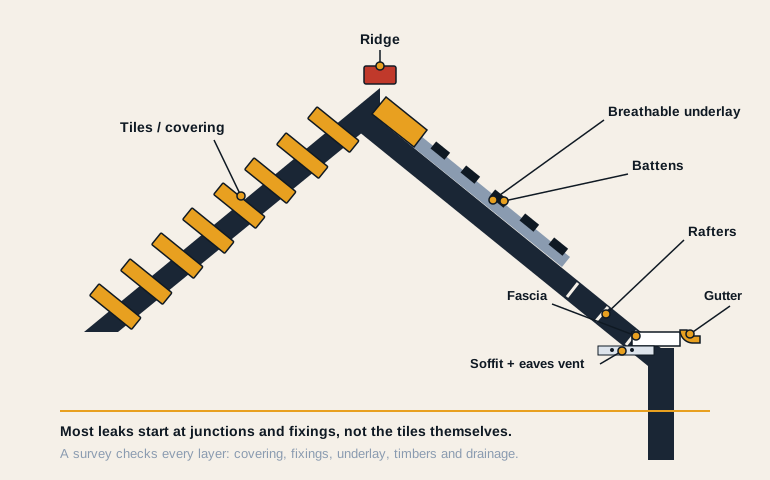
Coventry’s housing stock spans more than 150 years of construction, from Victorian terraces in Earlsdon and Hillfields to new-build estates on the city’s outer fringe. Each era has a distinct roofing profile: different materials, different failure modes, different maintenance requirements. This guide covers what to expect from each.
Victorian and Edwardian (Pre-1919) — Earlsdon, Hillfields, Foleshill
Original covering: Natural Welsh slate, steep pitch (45–50°), lime mortar throughout, lead valleys and chimney flashings. Construction era: 1870–1919. Current age: 105–155 years.
The characteristic roofing challenge on Victorian Coventry properties is nail failure without slate failure. Original copper or zinc nails last 80–100 years. Properties built in the 1880s and 1890s had their nails expire in the 1960s and 1970s. Many have had repairs since, but properties with original fixings throughout are now experiencing progressive slippage across the whole roof surface simultaneously.
The correct approach where slate is substantially sound: re-nail (strip tiles, replace battens, re-hang original slates with new stainless fixings). Cost on a standard Coventry terrace: £3,500–£6,000. This extends the roof’s life by 30–50 years and is significantly cheaper than full replacement. Where slate is too degraded or mismatched from previous repairs, full re-roofing in reclaimed Welsh slate is the appropriate specification.
Coventry’s post-war estates were built predominantly between 1945 and 1980, placing their concrete-tile roofs at or beyond design life today.
Source: own field data 2025
Interwar (1919–1939) — Coundon, Radford, Canley, Whitmore Park
Original covering: Clay or concrete plain tile, shallower pitch than Victorian (30–35° typical), hipped or half-hipped profiles, lime mortar pointing. Construction era: 1919–1939. Current age: 85–95 years.
The dominant maintenance issue on Coventry’s 1930s stock is hip tile failure. The mortar beds on hipped properties are exposed on three faces rather than one, and they deteriorate faster than equivalent ridge mortar on gabled roofs. Hip tile displacement after cold weather is the most common repair call from CV6’s interwar streets.
The mortar specification matters critically on 1930s Coventry properties. Portland cement repointing on interwar brickwork causes spalling — the cement is harder than the brick and forces the brick face off as the structure moves. All hip re-bedding and chimney repointing on 1930s Coventry properties should use NHL lime mortar. We specify this as standard on all pre-1950s work.
Post-War (1945–1980) — Wyken, Bell Green, Canley, Holbrooks, Binley
Original covering: Concrete interlocking tile, shallow to medium pitch (25–35°), galvanised steel nail fixings, bituminous felt underlay. Construction era: 1945–1980. Current age: 45–80 years.
Nail sickness is the defining roofing issue of Coventry’s post-war era. Galvanised steel nails have a zinc coating that lasts 50–70 years before corrosion breaks through to the steel core and the nail begins to fail structurally. This is not a gradual process — once corrosion breaches the zinc layer, failure accelerates. Properties where nail sickness is advancing show the same pattern: a few slipped tiles first, then progressively more as each subsequent storm finds the next loosened tile.
The felt underlay on post-war Coventry properties has also exceeded its design life in most cases. Modern breathable membrane is the correct specification for re-roofing — it manages condensation significantly better than the original bituminous felt and does not require the same ventilation air gap.
1980s and 1990s — Walsgrave, Eastern Green, Newer Outer Suburbs
Original covering: Concrete interlocking tile (still serviceable, mid-life), uPVC fascia and soffit (first replacement cycle), felt flat roofs on rear extensions (second re-covering cycle). Construction era: 1980–1999. Current age: 25–45 years.
1980s and 1990s Coventry properties are entering the first significant maintenance phase. The roof covering itself is generally sound — 40–45 year old concrete tiles are mid-life. But the peripheral elements are reaching end of life: original uPVC fascia is yellowing and becoming brittle, flat roof extensions are on their second or third felt re-covering, and first-generation guttering systems need replacement. We survey across all of these elements in a single visit.
Free Survey Specific to Your Property Era
We know what to look for on every Coventry housing era. Call 0247 798 1271 to book.
📞 Call 0247 798 1271 — Free Quote