Home › Services › Block Management Roofing Coventry
⭐ 4.9/5 · 127 Google Reviews · Free Quotes
Block & Communal Roofing in Coventry
Roofing for Coventry blocks and communal roofs — managing agents, freeholders, RTM companies and residents' associations. Section 20 consultation support, condition surveys with reserve-fund forecasts, and works managed around residents.
For block and communal roofing in Coventry we work with managing agents, freeholders, RTM companies and residents' associations — flat and pitched communal roofs, Section 20 consultation support with itemised specifications and estimates, condition surveys with 5- and 10-year reserve-fund forecasts, and scaffold licences with resident communication managed throughout.
Communal roofs sit outside any single leaseholder's responsibility — they're the freeholder's or the management company's to maintain, funded through the service charge. If you manage a block in Coventry and you're seeing recurring leaks into top-floor flats, failed flat-roof coverings over communal areas, or a roof approaching the end of its life, you're at the point where planned works and a proper Section 20 process are needed.
When it is NOT yet a major-works job
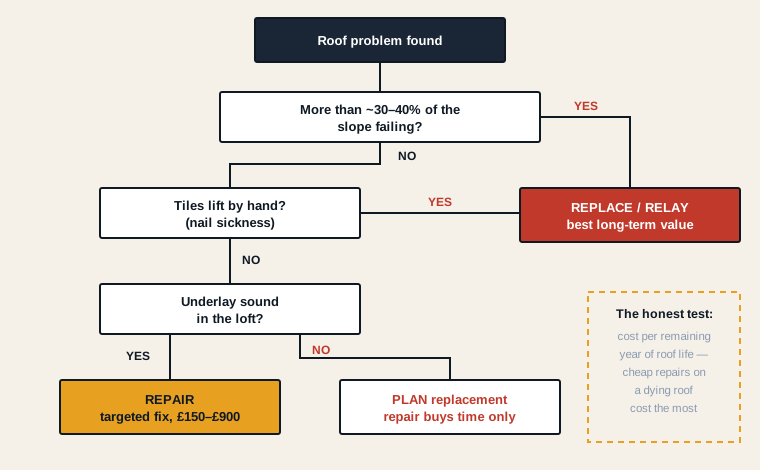
Not every leak is a re-roof. A single failed flat-roof outlet or a slipped run of tiles is a reactive repair, usually well under the Section 20 threshold, and treating it as major works wastes leaseholders' money and time. We'll tell you honestly when a targeted repair keeps the roof going for several more years versus when the reserve fund genuinely needs to plan a full replacement.
Repair-or-replace decision logic — the same framework we apply to communal roofs.
Local knowledge
Coventry's Flat and Communal Roof Stock
Coventry has a substantial stock of purpose-built flats and converted-flat blocks, and it drives a steady stream of communal roofing work. The post-war and 1960s–70s low- and medium-rise blocks across the city — around Hillfields, Wood End, Bell Green and the inner ring — typically carry large flat or shallow-pitched communal roofs, many originally felted and now well past their design life.
The city-centre regeneration of the last two decades has added newer apartment developments with modern single-ply and warm-roof communal decks, while the Victorian and Edwardian conversions in Earlsdon, Stoke and Chapelfields bring pitched communal roofs shared between flats. Each type needs a different specification, and a managing agent's reserve-fund planning depends on knowing which is which.
Named areas of flat stock
We survey and quote communal roofing across Coventry's flat stock — the ring-road and Hillfields blocks, the student-let conversions around the universities in Earlsdon and Canley, and the newer city-centre developments. Naming the block and its roof type in the reserve-fund forecast is what turns a vague 'roof needs doing eventually' into a costed line item leaseholders can plan for.
The process
How a Block Roofing Project Runs
1. Condition survey and forecast
We survey the communal roof and provide a written condition report with 5- and 10-year cost forecasts — the document managing agents and RTM directors use to plan the reserve fund and demonstrate proactive management to leaseholders.
2. Specification and itemised estimate
For works over the Section 20 threshold we produce a detailed specification and itemised estimate that meets the consultation requirements — the paperwork the process depends on, not a one-line quote.
3. Section 20 consultation support
We support both stages of the statutory consultation: the notice of intention and the estimates stage, providing the detail leaseholders are entitled to see and responding to observations through the agent.
4. Scaffold, works and resident communication
We arrange scaffold licences with Coventry City Council, communicate access and timing to residents in advance, carry out the works with communal areas kept usable, and hand over guarantee documentation for the block's records.
Timescales
Block Roofing: Typical Timescales
Stage
Typical duration
Condition survey + forecast report
1–2 weeks to report
Section 20 consultation (both stages)
~2–3 months (statutory notice periods)
Communal flat-roof re-cover
1–3 weeks on site
Pitched communal re-roof
2–6 weeks depending on size
The consultation timetable, not the roofing, usually sets the overall programme — we build the works schedule around it.
Access
Getting Safely onto Coventry Roofs
Communal roofs almost always need full scaffold given their size and the need to keep resident access safe below. Scaffold is specified for: all communal re-covers and re-roofs, plus most surveys of medium-rise blocks - always itemised in your written quote, never a hidden extra, and we arrange it.
Coventry's post-war estates scaffold easily, but the Victorian terraces of Hillfields, Foleshill and Earlsdon often have no rear vehicle access, so scaffold is worked in from the front. Pavement scaffold and skip permits go through Coventry City Council; allow a few working days on streets like the terraced streets off Foleshill Road, the Victorian rows in Earlsdon and Chapelfields where space is tight.
Pricing
Block & Communal Roofing: Cost Guide
Work
Typical range
Notes
Condition survey + 10-year forecast
£450–£1,200
Per block, size-dependent
Communal flat-roof re-cover
£90–£140/m²
Single-ply / GRP
Pitched communal re-roof
£85–£240/m²
By covering type
Reactive communal repair
£150–£900
Usually below S20 threshold
Section 20 specification pack
Provided with estimate
Meets consultation requirements
What moves the price
Block height and whether medium-rise access equipment is needed
Covering type — single-ply and warm-roof systems cost more than basic felt but last far longer
Scaffold duration and resident-access protection requirements
Whether works can be phased across the block or must be done in one programme
Worked example: A 1970s low-rise block off the Hillfields ring with a 320m² felted communal flat roof, re-covered in single-ply with new outlets and insulation upgrade: in the region of £34,000–£46,000 including scaffold — which at, say, 12 leaseholders crosses the Section 20 threshold and triggers full consultation.
No payment before materials are on site. Staged payments on major works, aligned to the agreed programme and the block’s service-charge / reserve-fund arrangements. VAT charged as applicable.
Guarantee
The Guarantee in Plain Terms
Workmanship on communal roofing works is covered for 10 years in writing, with manufacturer warranties on single-ply and warm-roof systems on top — documentation we hand to the managing agent for the block's records and the reserve-fund file.
Covered: workmanship for 10 years, in writing, transferable if you sell.
On top: manufacturer warranties on materials (terms vary by product).
Not covered: storm or impact damage - that is an insurance matter, and we will document it for your claim.
If a fault appears in covered work, we come back and put it right. No quibbling, no re-charge.
Under Section 20 of the Landlord and Tenant Act 1985, landlords and managing agents must formally consult leaseholders before carrying out qualifying works costing any single leaseholder more than £250, following a two-stage notice and estimates process.
Source: Landlord and Tenant Act 1985 s.20 / The Property Institute (TPI) guidance
Communal roofing is disruptive by nature — scaffold up for weeks, noise over occupied flats, and access to keep clear. We manage it with advance written notice to residents through the agent, scaffold alarmed and safely hoarded at ground level, works sequenced so no flat loses roof cover overnight, and a single point of contact for resident queries so the managing agent isn’t fielding them all.
Coventry's inland West Midlands climate means wind-driven rain from the south-west is the main roof stressor, and shaded north-facing slopes hold damp and moss. We build weather margin into the programme and keep temporary weatherproofing ready so an exposed section is never left open to a Coventry downpour.
Reviews
What Coventry Clients Say
★★★★★
“As managing agent for three Coventry blocks I need a roofer who understands Section 20, not just tiles. Their specification and estimate pack made the consultation straightforward and the leaseholders could see exactly what they were paying for.”
Managing agent
Hillfields · Communal re-cover + S20
★★★★★
“Our RTM company needed a ten-year forecast for the reserve fund. The condition survey was thorough and costed properly — we can finally plan instead of reacting to leaks.”
RTM director
City centre block · Condition survey
★★★★★
“Communal flat roof over the entrance had leaked for years. Re-covered in single-ply, scaffold managed with proper resident notice, no complaints. Documentation all filed for the block.”
Freeholder
Wood End · Communal flat roof
FAQ
Frequently Asked Questions
Section 20 of the Landlord and Tenant Act 1985 requires managing agents and freeholders to formally consult leaseholders before qualifying works that cost any single leaseholder more than £250. It's a two-stage process — notice of intention, then estimates. We provide the itemised specification and estimates the consultation needs.
Yes — managing agents, freeholders, RTM companies and residents' associations. We provide the specifications, itemised estimates, condition surveys and forecasts that block management and the Section 20 process depend on, and we communicate with residents throughout the works.
Yes. Our condition surveys include 5- and 10-year cost forecasts so you can plan the reserve fund and demonstrate proactive management to leaseholders, rather than reacting to leaks with unplanned major-works bills.
The roofing itself is usually 1–6 weeks depending on size and type, but the Section 20 consultation timetable — roughly 2–3 months across both statutory stages — normally sets the overall programme. We schedule the works around the consultation.
We do. We arrange scaffold licences with Coventry City Council, give residents advance written notice of access and timing through the managing agent, and provide a single point of contact for resident queries during the works.
Both flat and pitched communal roofs — the felted and single-ply flat roofs on the city's post-war and modern blocks, and the pitched communal roofs on Victorian and Edwardian conversions in areas like Earlsdon and Stoke. We specify the right system per roof type.
Yes. We sequence works so no flat loses roof cover overnight, hoard and alarm scaffold safely at ground level, and keep communal entrances and access clear. Resident disruption is planned down, not left to chance.